 A portion of the actual river
A fairly long time ago, in a place not so far from where I sit writing this, lived a young boy who had far too much curiosity, energy, bravado, and spare time on occasion for his own well being. To complicate matters more, he was pretty much a loner with the exception of about four other lads who shared the same traits and who would join together in a loose knit group at times to pursue adventures that were often not well advised, planned, or executed.
 On those days (or nights) that they all found themselves restless and lacking any real plans for their rare 'free time', they seemed to possess a hunger for adventures that were usually not 'really' forbidden, either by lack of rules prohibiting the behavior, or a tacit understanding that their efforts at having fun would not be well received should the activities in question 'come to the attention of ' certain people, namely adults.
 While never really harming themselves (too badly) or destroying anything (beyond repair), the group nevertheless garnered the oft-employed name 'usual culprits' when their actions came to be discovered, which was more often the case than not. Let us say they were not masterminds at 'covert operations'.
 They'd have been caught more often had there not existed at that time a sole Town Constable who worked evening weekdays only. His time was generally spent snoozing in his Chevy, which substituted for a real patrol vehicle.

Having known these boys in passing, their shenanigans were not unfamiliar to me, especially the ones involving the local 'spur' line of the railroad which ran to their town from the neighboring country which is very fond of maple leaf emblems. At the upper edge of the log booms feeding the local mill on the river was situated an iron railroad bridge which crossed into the other country without benefit of customs inspectors or regular (or irregular) border guards on either side. This was well prior to the modern era of border security attempts. Being just up-river of the booms meant that during most of the warmer days of the short summer the water beneath the iron bridge was clear for diving and swimming, sort of.
 It was also very irksome to the train crews who came through at regularly scheduled times to have those young scofflaws wave happily at the passing trains while leaning on the railroad company's 'No Trespassing Under Full Penalty of The Law' signs.
This was well prior to the modern era of border security attempts. Being just up-river of the booms meant that during most of the warmer days of the short summer the water beneath the iron bridge was clear for diving and swimming, sort of. It was also very irksome to the train crews who came through at regularly scheduled times to have those young scofflaws wave happily at the passing trains while leaning on the railroad company's 'No Trespassing Under Full Penalty of The Law' signs. 
They weren't usually too happy about kids climbing their bridge either. Something about 'getting sued', a term most were pretty unfamiliar with in those days, other than knowing the guy who lost his leg in the wood room of the mill sued and didn't work, yet drove a new car to his nice house.
 As for the actual danger involved, that's true if you count the 'deadheads', logs saturated with water on one end and partially sunken like an underwater picket fence. Needless to say, these were rather hazardous to divers descending from the top girders of the bridge to the dark waters below.
 For this reason, if swimming was the agenda, twine and small plastic bottles, usually old bleach bottles, were deployed in and around the diving area like so many fishing bobbers to mark the positions of the deadheads.
 One flaw in this system was that the current was rather strong, the water rather deep, and the 'de-barking' plant only a short way up-river and out of sight of the bridge. The de-barker and bark piles leached a continual flow of tannin-like bark juices into the river and greatly hindered visibility and the ability to find all the deadheads in the area. This also doesn't take into account the fact that additional partially sunken logs continued to drift a few feet below the water surface toward the mill's chutes downriver. This meant that the de-barking plant missed a great many of these which then passed under the rail bridge. Add the lack of EMS, an ambulance, or phone service near the bridge, and you can see why the ever unreasonable adults attempted to discourage any swimming in the very waters and conditions which they themselves had enjoyed at those ages.
 Plus, now there were white plastic bottles, which they did not have, relying instead on pieces of rags attached to sticks by twine as buoys. The 'new' system was obviously far superior to theirs. There was always the warning that you'll 'break your necks' falling from the upper girders with your wet, slippery feet. All of which the kids were well aware and blissfully dismissed as so much 'grown-ups not wanting them to do anything fun'.

I just recalled this as I was watching the local train cross over the iron bridge here in our present 'hometown'. It also stirred up some old memories I hope to share in the future for any who are interested. Until next time, take care and be well.


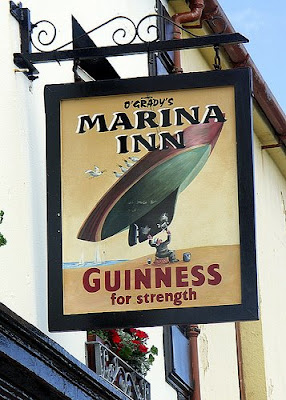 The tradition of hanging signs inside and outside pubs is well established in Ireland but dates back to the fourteenth century when the English King Richard II decreed that landlords were compelled to place signs outside their commercial establishments, pubs, hotels, etc. Irish public houses did not comply as readily as their English counterparts and often the name of the owner alone adorned the tavern front.
 Irish pubs also acted as 'spirit grocery' shops and some even acted as insurance agents and undertakers, a tradition which can still be found in some Irish towns in Ireland today.
 Signs began to develop and became more elaborate and decorative. Many of the earliest signs would not have included any text as the majority of the population were illiterate. Symbols and pictures were thus used to illustrate the function of the business displaying the sign. In latter years the name of the landlord was added. It was not uncommon (and is not uncommon in Ireland in modern times) for public houses to display the family coat of arms either on their pub-sign, or on the window of the establishment.

 Great battles and historical events also proved popular subjects for both pub signs as well as for naming the public house in question. Heroes of Irish literature such as Yeats, Kavanagh, Shaw, Joyce and Beckett also provide a great source of pub naming and signage. A fine example of this naming tradition is the 'Bleeding Horse' pub which is located on Camden Street in Dublin city centre and dates from 1649.


 The tradition of Irish pub signs was brought to the new world during the mass emigrations of the nineteenth and early twentieth centuries. The subjugation of the Irish people in certain eras is also evidenced by the use of (by now infamous) derogatory signs such as 'Help Wanted - No Irish Need Apply!'. Many of the modern Irish signs outside of Ireland reflect the tradition of the emigrants and can display a certain amount of wit or sentimentality. Shamrocks and Harps, the great symbols of Ireland, are often found on such signs.


