Ahhhhhh. After too much time away, finally able to get blogging in earnest again, or probably for the first time. I've been trying for some time to get back to it, but the old grey cells have failed to find the writing rhythm needed. Tonight, the Blogging Muses took a bit of pity on me and at the same time reminded me of the signs often seen in non-English speaking countries. the fun ones to look for are the ones we called 'Minglish' or 'Booklish'.
Minglish is English mingled with the local lingo usually spelled phonetically. Booklish is when a non-English speaker looks up translated phrases or words to say the same thing as in their own language. Often you can get the drift of the sign, but generally it's still funny. It seems the practice has progressed through being used when writing assembly instructions and safety labels to the present incarnation, SPAM!!
The following was posted to this blog today and is just too screwy to keep to myself. Normally I just go to the 'moderate' page and mark them as SPAM. I just wonder how long the writer spent on literally translating the thing, word by word. I almost called the number it gives just to find out how the phone would be answered, but stopped when I realized they might put my number in their call computer and dial it every day. Arrrrrgggghhhh! HELL NO!! At any rate, here it is, I hope you have a chuckle trying to figure it out.
Anonymous has left a new comment on your post "April Fool's Day Theories (some anyway)":
We Accept Houses With No Even-handedness,We Bribe Any Houses,We take Through Payments.Please pack make on
http://www.cashsellfast.com and irritate furnish in 48 hours
or call us 410-978-7981,please refer to friends who needfulness help.Bless day!
Distinction Landlords and Rehabbers:
If you are a solemn investor buying at least inseparable descendants per thirteen weeks as a replacement for rental or rehab,
then you are in the truth place veracious now.
http://www.renewreality.com.
Holder Financing May Be The Secret Colloidal suspension Learn How To Own A Home Without Dealing With A Bank!
Meet with The Abhorrent Truth In all directions Renting & Why It May Be Frame You Secretly Financially??¦ Gain
Insider Secrets on How Holder Financing Really Works
http://www.reimatcher.com/Baltimore/Reality_properties/sp1.
Lack Fresh Start? We can help.Painting proprietorship can paint your domicile within desired loiter again and again shape,
in colors of your pick with win out over discounts with a view paints,with admissible alongside character quality.
Above-board prices,references,certify,fetters,insuranse.For pictures of your works gladden drop in on
http://www.renewhouse4u.com
Gotta admit, the person was ambitious and also offered a way for me to start writing anew, although that wasn't their intention. Until next we meet, stay safe and take care.
Showing posts with label signs. Show all posts
Showing posts with label signs. Show all posts
Saturday, June 04, 2011


Monday, September 01, 2008
A Bit O' Irishness.....
Since my eyes still aren't up to much use, here's a little information from an Irish Newsletter I subscribe to. I'm a great fan of Ale, Scotch, AND Irish Whiskey. Perhaps my having a great grandfather who was half Irish would account for that. Or, maybe I was just blessed with the ability to recognize quality beverages. After all, I'm also a big Moxie soda fan. I'll leave you to the reading as I seem to have developed an over-powering thirst for some Jameson's.
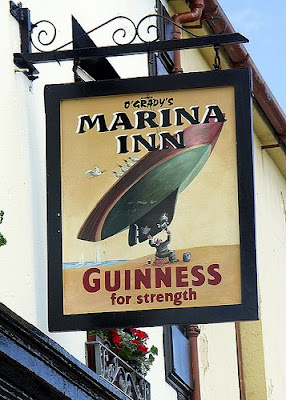 The tradition of hanging signs inside and outside pubs is well established in Ireland but dates back to the fourteenth century when the English King Richard II decreed that landlords were compelled to place signs outside their commercial establishments, pubs, hotels, etc. Irish public houses did not comply as readily as their English counterparts and often the name of the owner alone adorned the tavern front.
 Irish pubs also acted as 'spirit grocery' shops and some even acted as insurance agents and undertakers, a tradition which can still be found in some Irish towns in Ireland today.
 Signs began to develop and became more elaborate and decorative. Many of the earliest signs would not have included any text as the majority of the population were illiterate. Symbols and pictures were thus used to illustrate the function of the business displaying the sign. In latter years the name of the landlord was added. It was not uncommon (and is not uncommon in Ireland in modern times) for public houses to display the family coat of arms either on their pub-sign, or on the window of the establishment.

 Great battles and historical events also proved popular subjects for both pub signs as well as for naming the public house in question. Heroes of Irish literature such as Yeats, Kavanagh, Shaw, Joyce and Beckett also provide a great source of pub naming and signage. A fine example of this naming tradition is the 'Bleeding Horse' pub which is located on Camden Street in Dublin city centre and dates from 1649.

The tradition of hanging signs inside and outside pubs is well established in Ireland but dates back to the fourteenth century when the English King Richard II decreed that landlords were compelled to place signs outside their commercial establishments, pubs, hotels, etc. Irish public houses did not comply as readily as their English counterparts and often the name of the owner alone adorned the tavern front.
Irish pubs also acted as 'spirit grocery' shops and some even acted as insurance agents and undertakers, a tradition which can still be found in some Irish towns in Ireland today.
Signs began to develop and became more elaborate and decorative. Many of the earliest signs would not have included any text as the majority of the population were illiterate. Symbols and pictures were thus used to illustrate the function of the business displaying the sign. In latter years the name of the landlord was added. It was not uncommon (and is not uncommon in Ireland in modern times) for public houses to display the family coat of arms either on their pub-sign, or on the window of the establishment.
Great battles and historical events also proved popular subjects for both pub signs as well as for naming the public house in question. Heroes of Irish literature such as Yeats, Kavanagh, Shaw, Joyce and Beckett also provide a great source of pub naming and signage. A fine example of this naming tradition is the 'Bleeding Horse' pub which is located on Camden Street in Dublin city centre and dates from 1649.

One explanation of the name is that horses used to be 'bled' after arriving at this stopping point as a means of reducing their blood pressure and calming them after their journey. Another legend relates to the 1649 Battle of Rathmines when injured horses were put to death nearby after the battle. A further explanation of the name tells how a bleeding horse wandered into the tavern after the Battle.

 The tradition of Irish pub signs was brought to the new world during the mass emigrations of the nineteenth and early twentieth centuries. The subjugation of the Irish people in certain eras is also evidenced by the use of (by now infamous) derogatory signs such as 'Help Wanted - No Irish Need Apply!'. Many of the modern Irish signs outside of Ireland reflect the tradition of the emigrants and can display a certain amount of wit or sentimentality. Shamrocks and Harps, the great symbols of Ireland, are often found on such signs.

Sign at a pub in Canada
For more information on Ireland, Irish goods for sale, and most things you'd need to link to, these things & much more can be found at: free Irish resources 

Thursday, July 19, 2007
Road Signs
This is just a very brief tale I was reminded of a bit ago by a little talk on a guest book I visit concerning road construction. This series of events occurred over a period of only one long day during one of my stays in the quaint Asian country known in the west as Japan. It was inevitable that the foreigners working in the country would eventually wind up dating, living with, and often marrying members of the opposite sex they'd meet there. This held true for both genders, and, minus the marriage vows, gay and lesbian folks as well. This often led to discovery of amusing little quirks of their culture by us, and vice versa. One of the biggest sources of amusement to westerners is usually the way the foreign languages are interpreted by the Japanese. They have other little quirks that accompany those of foreign language translation and application.
The amusement factor extends into other areas of language as well, which I learned over a period of years. One of the greatest suppliers of the humor came in the form of a very pretty, petite, college educated young lady who lived with my very good friend, co-worker, and fellow motorcyclist during this particular time frame. They would eventually marry and spend part of the year in his home state of Minnesota and the remainder in Japan and travelling around Asia purchasing items for their import/export enterprise. It was often our custom to spend Sundays in the nicer weather months on longish cruises around the countryside. This always provided a bit of history, adventure, fun, and considerable frustration on rare occasions.
As no good maps were readily available in English at that time, we generally dispensed with that bit of frivolity and "flew by the seat of our collective pants". Often this required a short conference and subsequent vote as to which particular path of travel would result in our being "the least lost", or somewhat in doubt as to our real location from moment to moment. We always took comfort in the fact that we were on an island, a somewhat large island, but an island nonetheless. That meant that, being surrounded by water, if we'd travel in any one direction long enough we'd find salt water. That being accomplished, it would be just a matter of a few days riding around the perimeter of the place before we'd get home, home being on the seaside for me and nearby for them. A great way to discover new people, sights, and geological features. Unless it was getting late and we were weary.
At those times we'd turn to our intrepid "secret weapon", our own Japanese person Yoshiko, who we knew would be of great assistance if asked. At least that was the theory until one day when we actually swallowed our pride and admitted to being "confused" beyond our usual degree of disorientation. When we finally got to the point of informing her we might possibly need directions from the local inhabitants, she cheerfully agreed to approach an officer in the local "Police Box", the peculiar little structures all over Japan from which the neighborhood policemen operated. After observing her and the nice officer discussing our plight accompanied by much gesturing and bowing, we were finally rewarded by seeing her heading toward us with a typical Japanese smile on her face. My friend, knowing her much better than I, immediately shook his head, exhaled loudly, and exclaimed "Oh shit!" softly to his boots. I'd forgotten one peculiar aspect of Japanese society in my joy at seeing the smiles and nods exchanged by Yoshi and the officer.
In Japanese society, it is unthinkable to give a negative reply to a question, rather, the question must be phrased in such a way as to allow the answering party to reply in the positive that a negative is the case. For example, if you go into a small shop to purchase mosquito repellent tablets to use in your nifty little Japanese mini hot plate to rid your residence of the pests(don't understand to this day why they don't sell them here in the USA) and ask the proprietor if they have the item, the answer is ALWAYS "Hai, so desu ne!" "Yes, that is true." This is the answer whether they have them or not, as if not, it's understood by the shop owner that they carry them, but they're out at the moment. This isn't a problem to Japanese or long-term foreigners as the phrase comes with two types of smiles. Smile one is the "of course, and I'll happily sell you some". Smile two is the somewhat embarrassed "we should be able to sell you some and would happily do so if we in fact had them in stock". To the practiced foreigner or native Japanese, this difference is readily apparent, and requires a polite nod, and a statement to the effect that "I see, I understand you have no tablets at this time", which always gives the now ecstatic shopkeeper the proper outlet by saying, "Hai, so desu ne!". The notable difference is that now he's agreeing that they have none, he's happy, you can continue to another shop, and all's right with the world again.
Another aspect of the positive answer is very familiar to old Japan hands. In this type answer, which unfortunately for us was what had transpired between Yoshi and the officer, person one makes a statement to person number two. Person two smiles, nods, and politely says the familiar phrase of agreement. However, in this case it doesn't mean agreement but acknowledgement of person one's statement. It does NOT mean agreement, only that "yes, I heard you, but I have absolutely zero idea what you actually said". Again, the Japanese person or old hands recognize the accompanying smile type, and promptly begins the necessary ritual of saying commonly understood phrases such as "thank you" (for acknowledging my right to speak), "I'm so very sorry for taking up your valuable time", and other necessary niceties which are always accompanied by much bowing and smiling. After sufficient apologies, hand gestures, and smiles, both parties feel comfortable with each other's politeness and disengage from the conversation amid much further bowing and smiling. Apparently we'd wandered far off the beaten path to a place where poor Yoshi, coming from a southern city, couldn't comprehend a word that the officer spoke, any more than he could understand her. It was the "Okay, I tried, I failed miserably, and now I must apologize to my friends" smile my pal had detected.
After much discussion, it was decided that we'd continue on, using the now setting sun for guidance until we reached a major byway. Finally it happened, after about an hour of steady riding through the rolling countryside we came to what was obviously a major thoroughfare. Sadly for us, our hopes of a quick resolution were shattered when, after about ten kilometers, we came to a spot where the road split into three major roads, each heading in the same general direction, but with vastly different destinations. I should point out here that the road was a "high speed" road, which in Japan is about sixty kilometers per hour speed limit, or roughly 37.5 miles per hour. Due to this limit, and the general impossibility of faster travel because of traffic density, a slight deviation could result in a 40-50 mile distance between the road's terminus and our destination. Therefore, it was necessary to get the correct path the first try. For this, our college educated Yoshi would be pressed into service once again.
It was then that my friend and I learned a new lesson about Japan and Japanese road signs of that era, actually it was more about the painters of said road signs. Yoshiko got off the bike, walked tentatively toward the signs having directional information, studied the thing a long time, then spun about and ambled slowly back in our direction with that same "I'm so very sorry smile" on her face, which elicited another "Oh shit!" from my buddy. This time, even though neither of us knew the problem yet, we both knew that smile boded no good for us. Sure enough, when she finally spoke, it was in answer to his question "Did you read the sign?", to which she, being Japanese and all, nodded and answered in the affirmative. He then logically, to us, asked which way we should go, to which the only reply was an enigmatic smile and a nervous head nod. "Do you not know the way now?", he asked, eliciting a happy smile and an affirmative answer accompanied by much bowing, to which it was my turn to exclaim, "Oh shit!", as I'd just realized what had transpired. My pal and I looked at each other and shook our heads in final recognition of what had been said: "Yes, I do not know the way now!", the perfect polite answer giving her the face saving way out.
The next little bit isn't fit to write for a polite audience, such as the readers of this missive. Suffice it to say the words were very colorful in both their meaning and inflection, and it reflected the frustration of daily dealing with an infuriating custom, maddening to us at any rate. The conversation went along these general lines, "The sign's in Japanese, right?", happy affirmative and nod with smile. "And you're Japanese, right?", same answer. "So you can read Japanese, right?", again with the yeses. "You read the sign, right?", yesiree!! Smile nod, but not a happy smile and nod. Another "Oh shit" from him. "Did you not understand what it said, it being Japanese and all?", BIG smile, BIG affirmative, BIG nod, BIG "Oh for C*****'s sake!!". Much silence, finally broken by my friend's tentative "Why did you not understand the Japanese sign, written in Japanese language, on this Japanese road, since YOU ARE JAPANESE?" No smile, just shock at his insensitivity to her efforts to end the conversation politely.
Now, I tried a few simple questions, which FINALLY got to the crux of the difficulty with the sign. It seems that, as with the language problem previously, all rural areas of Japan have their own sign painters, and every one has his own artistic flair which he, or she, incorporates into their signs. This is fine for the locals, who understand what the signs are supposed to say, being familiar with the area and all, but generally of absolutely no help whatever to those persons who pass by that are from other areas of the country. And so, despite having a genuine Japanese person, highly educated at University of Tokyo, as our personal guide and translator, we finally just had Yoshi toss a pebble at the sign and took the route indicated where it hit. This resulted in our being only about 20 miles from our destination when the road ran out, which, I found out later, was excellent luck as the other wrong branch would've taken us over 50 miles from home at its terminal point. Just another lesson in Japanese culture and language, along with a not unpleasant ride. Until next time, take care.
Subscribe to:
Posts (Atom)