
Harvesting Pie Filling
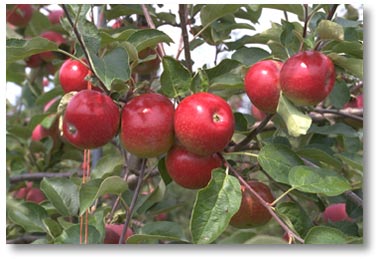
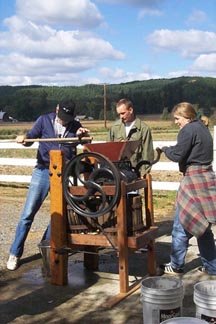
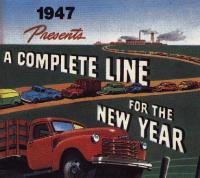
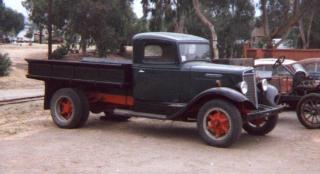
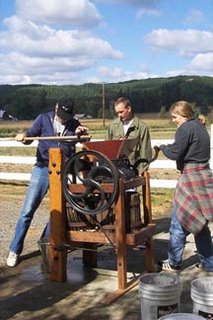
As I mentioned earlier, F had apple orchards and scattered apple trees on his farm which were grown, tended and harvested like any of the other crops. This harvest, we generally had only two to three weeks to complete due to the weather. It was also important to get the fruit before it fell from the tree and got damaged or eaten by the local wildlife. Photos above show some farm trucks as we had, which were an extremely important part of harvesting and marketing the apples. The top is an advertisement for a truck like F's 1947 GMC 4400, the "new truck" until 1957. Next is R's main truck which he used until getting the "new truck" in 1957. F didn't feel the need for a new truck until around 1964 or so. R's truck, which I drove the most, was a 1936 International Harvester. He also had an "old truck", a Model T Ford, on which I first learned to drive something other than horses and tractors. The Model T was rather worn out and used only on the farms, as it was somewhat of a road hazard. Next is a picture of apples ready to be picked, and finally, an example of a cider press similar to ours. This press gave myself and F a real workout every evening after picking was done for the day.
Since we had so many trees and so few of us, this was one of the few times outside help would be employed. The other time was to rake the blueberries in our small blueberry barren. During her milk deliveries, my aunt would leave notices at the local schools advertising for apple pickers. Mostly they would be teens and some men and women from the Indian Lands. Many of my biological relatives and I met this way for the first time. Although most of the Indians worked in the mills and woods or fishing, a large number still pursued more traditional lifestyles, and would pick apples, potatos, or rake berries for added income between seasons. Every day during picking weeks, F and I would go to the local high schools and pick up those teens who signed up to work. By doing so they'd be excused from school for the day. The same was true of bean pickers and potato pickers as the need for added help arose. R would take my cousin and go to the Indian Lands Catholic Church to pick up those Indians who signed up. Today you'd be fined for riding all those folks in the back of a stake-bed truck with no seats, or for hiring the teens without state permission.
We had four main orchard areas and a number of scattered trees that were harvested. I'm not sure how many trees F had total, but it was a lot. Though not as big as most orchards today, I'd guess that every grove had about 75-100 trees in rows of six abreast. Apples and hay covered most of the cultivated areas of the farms, the garden areas were small in comparison. There were probably thirty scattered areas as well, with 1-10 trees in each. Mostly we grew McIntosh and Rome Beauties as they were, and are today still, highly marketable because of their versatility. They're good plain, in pies, applesauce, cider, etc.
After arriving at the farm, the pickers would be driven to the areas they were to pick. There they'd be given a shoulder sack of canvas in which to place the apples, which left their hands free. They'd also get what we called "apple ladders", these were simple, narrow, wooden ladders that R, F, and I built and repaired during the spring when the ground was too soft and muddy for doing much other than chores like that. The ladders fit into the trees very well and had canvas "caps" atop the side rails to prevent injury to the trees. This style ladder is still in use today by many orchards that hand pick their crops. As the sacks were filled, they'd be emptied carefully into bushel baskets placed on the ground beside the trucks. Each basket was assigned to the picker who was filling it and, when full, would be tallied by my cousin or I and loaded onto the truck. This was really one of the few times I ever saw the "princess" do anything useful around the farms.
At the end of the day, the pickers would wait while the trucks were off-loaded into F's barn. The trucks would then load them up and return them to where they were picked up in the morning. This would progress seven days a week until the harvest was completed. After we had eaten supper, F and I would take his truck to the orchard with empty baskets and gather all the "drops", those apples that had fallen to the ground. These were destined for the cider press to be chopped up and then crushed for their sweet juice. After all the drops had been pressed, F would strain the juice through cheesecloth into milk cans for later bottling. As he did this, it was my task to shovel all the apple remains into buckets and feed the pigs with it.
After the day's apples were harvested, my aunt and F's wife would go to the apple barn in the evening and sort them by type, size, and quality. In the afternoons Mrs F would open the little store in the city, after having used the milk delivery vehicle to transport the sorted apples. She'd only take some though, since most were destined for wholesalers in the south of the state who would send a big semi-trailer to pick up the harvest. All told, this time, like so many other periods on the farms, was a hectic flurry of activity from start to finish. There is one final note to this tale though, concerning the trees set aside for our personal use. These were the trees deemed to have the best fruit of all the scattered stands of apple trees.
I was introduced to this idea of separate trees my first year there by my uncle on the Thursday night just before the harvest started. I came in from my chores to find R in the pantry lettering crude signs to place in one of the scattered groves that was next to a dirt road frequented by local teens on weekend nights. After completing the signs, he took me, along with the signs, fence posts, 2 picking ladders, and a section of snow fence to the trees I mentioned. He proceeded to fence off the entire grove of about 10 trees, one of the larger scattered groups, except the three big trees closest to the road. These he isolated by running the fence behind them. He also allowed plenty of room at the ends of the fence for easy access to the main group of trees, and left the ladders under these trees in plain sight. Then he proceeded to post the signs directly in front of the three trees he'd isolated.
The next night being Friday, the usual group of teens were parked by the trees on the dirt road doing what teens with vehicles do everywhere. Saturday morning R took me to the grove to show me how effective his signs, which he'd been posting for several years, were in protecting the apples destined for our own use. To my surprise, his plan had worked much better than he'd hoped for, as there were a larger than usual number of teens there the night before. The apples meant for us, some of the best McIntosh apples on the farm, were untouched. The poor quality apples and crabapples were pretty much picked through. His plan was simple, his sign in front of the three good trees simply said, "Feel free to pick all the apples you can use, but please only pick the apples from these three trees. The rest of the grove has mostly apples so bad we feed them to the pigs." This went on until the three "good" trees were ready to be harvested. Meanwhile, the other trees were picked almost bare by the various teens parking there at night.
Sure enough, he'd gotten human nature right, the teens had picked the apples they were told NOT to pick and left the good ones for us. Hard to believe such a simple trick would work, but I guess it's the old concept of "forbidden fruit tasting best." I've always remembered how that trick worked every year I was on the farm, each year bringing a new bunch of apple "thieves" unwilling to believe it when told the truth about the apples. Until next we meet. Take care..

 A Short Account of My First Money-driven Enterprise
Although I worked long hours around the farms, I received no wages. I think it was assumed it was in exchange for my room and board. What I now know, is that the most valuable thing I earned there was a set of life lessons that have served me exceedingly well over the years. I did, however, wish to have some money of my own, other than what I got sporadicaly from Dad or my uncle. It was this desire for financial freedom of a sort that led to my devising many ways of generating income over the years. I've been lucky in that the very worst of my efforts and ideas have resulted in breaking even. Some have provided a good return, and most a modest return. To this day I seem to always be on the lookout for a "project" of some sort.
My first effort took place in the winter of my first year on the farm and, as much as I hate to admit it, my cousin "the princess" was the inspiration. She was in her early teens and had just been "discovered" by the local boys, who came in an endless line to take her places now uncle R allowed her to go on dates. One factor of these outings seemed to be more beneficial to myself and my aunt, both chocolate junkies. All these young men arrived bearing a gift, and it was invariably the same every week, a box of chocolates. This was, in my eyes, a wonderful thing, as "the princess" didn't care for chocolate and my aunt and I would have a good supply until the next "date" arrived. It got me wondering though, what else was there suitable to give a girl? On the next few trips on the milk route with my aunt, I did some quick investigating in all the local stores. They all offered the same gifts, chocolates and flowers. The flowers were far more expensive there in winter, so the chocolates were the obvious choice of those of meager means.
After running it around in my head for a bit, I settled on a plan. I would offer a treat "the princess" loved in hopes others would feel the same, or want something different. I also had observed the prices of the gifts on offer and thought I could at least equal them. The first step of my plan took me to the woodpile by the sugar house in search of the right material. I finally located a good-sized log of ash, a very hard and durable wood. Then to the workshop in back of the barn to see if I could fashion what I needed. The result was a wooden knife/spatula similar to the wooden knife pictured. Mine was a bit thinner with a fairly sharp edge. I then tested my knives on a few apples from F's storage cellar below his barn. Finding them up to the task, I proceeded to produce as many as I could get from the log.
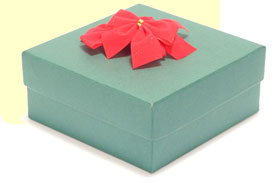
Step two involved bargaining with F and Mrs F for materials. From F I got an agreement to buy, on installments with immediate delivery to me, a quantity of McIntosh apples and honey. With Mrs F I struck a similar bargain for some jars she used for selling jams and the pretty boxes she sold the jams and jellies in. Then on to my aunt for a number of leftover bows of the type used for Christmas presents. I also got some old wrapping tissue and a bottle of glue. My operation was almost complete. The boxes, having dividers splitting them into four equal parts were perfect, that, and that they were in pinks, reds, and yellows. Into each box I placed three juicy, red apples, each wrapped in tissue. Then I added one of the small jars about three-fourths full of fresh honey. Lastly, I added a wooden knife to slice the apple and spread the honey along with five paper napkins appropriated from my aunt's picnic supply chest. Then on went the box lid with a pretty bow glued in the center and tied nicely with white string "borrowed" from my aunt.
Once I had fifteen of these packages ready to sell, I figured up all my expenses for the whole of my materials and arrived at a sum of $2.25 per box for the fifteen initial boxes. Then I added in fifty cents for the store owner and seventy-five cents for me. After discussing this with my aunt and Mrs F, they smiled and said it was a good idea, all the while exchanging those looks with each other that said I was a cute but silly eight-year-old boy with daydreams. This made me even more determined than ever to succeed.
So, the next morning I loaded all fifteen of my "gift" boxes in the station wagon to distribute while on the milk run. My aunt was confused when I said I didn't want to go to the grocery stores to display my goods, directing her instead to the drug store of the first town on our route. After a bit of haggling and receiving even more bemused smiles, I managed to talk all the drug stores, general stores, and most importantly, beer stores, to display my boxes , one opened for display, beside their candy boxes. The next day, much to my aunt's amazement, all of my boxes, even the display boxes were sold. It seems I figured rightly that folks wanted something different, many liked apple slices and honey, and my most important calculation, it had been payday when I first displayed them. I knew from my friends that many of their fathers stopped in the beer stores payday on the way home and most got something for their moms as well. This was probably to mitigate the anger received from the moms over the beer purchase. Whatever the reason for the success, I was elated, the store owners were happy for a quick profit for almost no work, and I was planning how many boxes to place the next week.
I figured that by only putting them out on paydays and special days, they'd seem more special. As I'd bought a fair quantity of materials and figured all my costs into the first fifteen boxes, it was a long time before all the sales weren't pure profit beyond the store's cut. I continued this into the late spring when I put it on hold until the next winter, when people were again cooped up in their houses and looking for something special.
I think the most satisfying part was when I went to the local bank with my profits and asked, very business-like, to speak to the bank manager. He, like my aunt and others had, treated me to a bemused smile when I said I wanted to open an account. I'll never forget the look on his face, after he explained how I needed at least one dollar to open an account and asked me in a condescending manner if I had that much and ended calling me "little fella", when I pushed $312.50 across his desk and asked if this was "enough".
I got my bank account and gained a bit of self esteem for being able to show people I could really do things. I'm not sure what course my life would've taken had this venture been a big flop. Thankfully, it proved to me that careful planning and attention to little things about people's behavior pays dividends. Until the next time, take care.
A Short Account of My First Money-driven Enterprise
Although I worked long hours around the farms, I received no wages. I think it was assumed it was in exchange for my room and board. What I now know, is that the most valuable thing I earned there was a set of life lessons that have served me exceedingly well over the years. I did, however, wish to have some money of my own, other than what I got sporadicaly from Dad or my uncle. It was this desire for financial freedom of a sort that led to my devising many ways of generating income over the years. I've been lucky in that the very worst of my efforts and ideas have resulted in breaking even. Some have provided a good return, and most a modest return. To this day I seem to always be on the lookout for a "project" of some sort.
My first effort took place in the winter of my first year on the farm and, as much as I hate to admit it, my cousin "the princess" was the inspiration. She was in her early teens and had just been "discovered" by the local boys, who came in an endless line to take her places now uncle R allowed her to go on dates. One factor of these outings seemed to be more beneficial to myself and my aunt, both chocolate junkies. All these young men arrived bearing a gift, and it was invariably the same every week, a box of chocolates. This was, in my eyes, a wonderful thing, as "the princess" didn't care for chocolate and my aunt and I would have a good supply until the next "date" arrived. It got me wondering though, what else was there suitable to give a girl? On the next few trips on the milk route with my aunt, I did some quick investigating in all the local stores. They all offered the same gifts, chocolates and flowers. The flowers were far more expensive there in winter, so the chocolates were the obvious choice of those of meager means.
After running it around in my head for a bit, I settled on a plan. I would offer a treat "the princess" loved in hopes others would feel the same, or want something different. I also had observed the prices of the gifts on offer and thought I could at least equal them. The first step of my plan took me to the woodpile by the sugar house in search of the right material. I finally located a good-sized log of ash, a very hard and durable wood. Then to the workshop in back of the barn to see if I could fashion what I needed. The result was a wooden knife/spatula similar to the wooden knife pictured. Mine was a bit thinner with a fairly sharp edge. I then tested my knives on a few apples from F's storage cellar below his barn. Finding them up to the task, I proceeded to produce as many as I could get from the log.
Step two involved bargaining with F and Mrs F for materials. From F I got an agreement to buy, on installments with immediate delivery to me, a quantity of McIntosh apples and honey. With Mrs F I struck a similar bargain for some jars she used for selling jams and the pretty boxes she sold the jams and jellies in. Then on to my aunt for a number of leftover bows of the type used for Christmas presents. I also got some old wrapping tissue and a bottle of glue. My operation was almost complete. The boxes, having dividers splitting them into four equal parts were perfect, that, and that they were in pinks, reds, and yellows. Into each box I placed three juicy, red apples, each wrapped in tissue. Then I added one of the small jars about three-fourths full of fresh honey. Lastly, I added a wooden knife to slice the apple and spread the honey along with five paper napkins appropriated from my aunt's picnic supply chest. Then on went the box lid with a pretty bow glued in the center and tied nicely with white string "borrowed" from my aunt.
Once I had fifteen of these packages ready to sell, I figured up all my expenses for the whole of my materials and arrived at a sum of $2.25 per box for the fifteen initial boxes. Then I added in fifty cents for the store owner and seventy-five cents for me. After discussing this with my aunt and Mrs F, they smiled and said it was a good idea, all the while exchanging those looks with each other that said I was a cute but silly eight-year-old boy with daydreams. This made me even more determined than ever to succeed.
So, the next morning I loaded all fifteen of my "gift" boxes in the station wagon to distribute while on the milk run. My aunt was confused when I said I didn't want to go to the grocery stores to display my goods, directing her instead to the drug store of the first town on our route. After a bit of haggling and receiving even more bemused smiles, I managed to talk all the drug stores, general stores, and most importantly, beer stores, to display my boxes , one opened for display, beside their candy boxes. The next day, much to my aunt's amazement, all of my boxes, even the display boxes were sold. It seems I figured rightly that folks wanted something different, many liked apple slices and honey, and my most important calculation, it had been payday when I first displayed them. I knew from my friends that many of their fathers stopped in the beer stores payday on the way home and most got something for their moms as well. This was probably to mitigate the anger received from the moms over the beer purchase. Whatever the reason for the success, I was elated, the store owners were happy for a quick profit for almost no work, and I was planning how many boxes to place the next week.
I figured that by only putting them out on paydays and special days, they'd seem more special. As I'd bought a fair quantity of materials and figured all my costs into the first fifteen boxes, it was a long time before all the sales weren't pure profit beyond the store's cut. I continued this into the late spring when I put it on hold until the next winter, when people were again cooped up in their houses and looking for something special.
I think the most satisfying part was when I went to the local bank with my profits and asked, very business-like, to speak to the bank manager. He, like my aunt and others had, treated me to a bemused smile when I said I wanted to open an account. I'll never forget the look on his face, after he explained how I needed at least one dollar to open an account and asked me in a condescending manner if I had that much and ended calling me "little fella", when I pushed $312.50 across his desk and asked if this was "enough".
I got my bank account and gained a bit of self esteem for being able to show people I could really do things. I'm not sure what course my life would've taken had this venture been a big flop. Thankfully, it proved to me that careful planning and attention to little things about people's behavior pays dividends. Until the next time, take care.