This article was recently published by CNBC and I thought it deserved as much attention as possible.
Spotting Counterfeit Bills. All photos by Fred LaSenna for CNBC.com
In order to stay ahead of counterfeiting, the United States government redesigns paper money on a fairly regular basis. The latest installment, a new $100 bill, is slated for unveiling on April 21. The last bill to be redesigned was the $5 bill, issued March 13, 2008.
Notable among recent design changes are the addition of colors to the bills. But there's a lot more to the redesigns than meets the eye. Literally.
Using a super-macro lens, we get up close and personal with the latest U.S. currency designs, showing in full detail some of the features you may not be aware of. And why only the very best counterfeiters in the world can pull off a bill so good that only experts can spot it as a fake.
Presidential Portrait
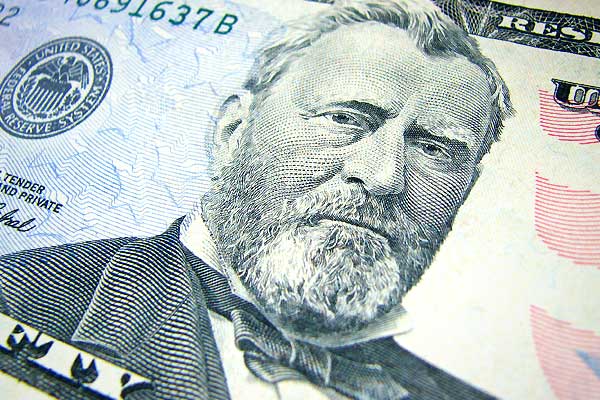
The portrait on a genuine U.S. note appears lifelike and stands out distinctly from the background. Counterfeit portraits are usually lifeless and flat, and details merge into the background, which is often too dark or mottled.
Pictured: $50 bill featuring President Ulysses S. Grant
Fine-Line Printing and Microprinting
Very fine lines have been added behind the portrait on the front of new series bills and on the reverse side scene to make it harder to reproduce. Note the words "U.S.A FIFTY U.S.A 50" on the $50 bill pictured.
Microprinting
Microprinting also can be found around the portrait. The words "The United States of America" are printed on Grant's collar on the $50 bill. (Note the words are only somewhat legible in photo 1 and look almost like a single line to the naked eye on a non-magnified bill.)
Federal Reserve and Treasury Seals
On a genuine bill, the saw-tooth points of the Federal Reserve and Treasury seals are clear, distinct, and sharp. Counterfeit seals may have uneven, blunt, or broken saw-tooth points.
Pictured: $100 bill.
Borders, Part 1
The fine lines in the border of a genuine bill are clear and unbroken. On the counterfeit, the lines in the outer margin and scrollwork may be blurred and indistinct.
Borders, Part 2
The borders also contain microprinted words barely visible to the naked eye. These words are difficult to duplicate and are rarely seen in counterfeit bills.
Paper
Genuine currency paper has tiny red and blue fibers embedded throughout. Often, counterfeiters try to simulate these fibers by printing tiny red and blue lines on their paper. Close inspection reveals, however, that on the counterfeit note the lines are printed on the surface, not embedded in the paper.
It is illegal to reproduce the distinctive paper used in the manufacturing of United States currency. Pictured: $5 bill.
Color-Shifting Ink
If you hold the new series bills (except the $5 note) and tilt them back and forth, you can watch the color of the numeral in the lower right-hand corner of the bills shift from green to black and back to green.
Counterfeit bills will often incorporate special inks that appear shiny and somewhat metalic, but whose colors do not shift.
Serial Numbers
Genuine serial numbers have a distinctive style and are evenly spaced. The serial numbers are printed in the same ink color as the Treasury Seal. On a counterfeit, the serial numbers may differ in color or shade of ink from the Treasury seal. The numbers may not be uniformly spaced or aligned.
On more recent issues, the serial numbers are actually embossed onto the paper making the numbers easy to feel on authentic bills.
Watermark
By holding a new series bill up to a light, the watermark becomes visible in an unprinted space to the right of the portrait. The watermark can be seen from both sides of the bill since it is not printed on the bill but is embedded in the paper.
Counterfeit bills sometimes attempt to duplicate this watermark, but they rarely look like the portrait they are supposed to represent. And counterfeits that use bleached, smaller denominations as the basis of the note will show a watermark that does not match the portrait. For example, if a $5 bill was bleached and reprinted to look like a $100 bill, the note will have Benjamin Franklin's portrait, but the watermark will clearly show Abraham Lincoln's face.
Pictured: $10 bill.
Security Thread
Like the watermark, the security thread can also be seen by holding the bill up to a light. This thin embedded strip runs from top to bottom on the face of a banknote.
In the $10 and $50 bills, the security strip is located to the right of the portrait, and in the $5, $20, and $100, it is located just to the left of the portrait.
Microprinting is used to write U.S.A 50 on the $50 bill pictured. Each denomination has its value printed similarly.
Ultraviolet Glow
While some high-quality counterfeits might have a well-faked security thread, there's still a simple way to spot whether the bill is genuine. If an authentic bill is held up to an ultraviolet light, the security thread glows.
The $5 bill glows blue, the $10 bill glows orange, the $20 bill glows green, the $50 bill glows yellow, and the $100 bill glows red.
Comparison
In spite of all of these security advances, Secret Service agents say the best way for the general layperson to tell if a bill is real is to feel it. Compare the feel and texture of the paper of a suspect bill with other bills that you know are authentic.
Of course, some critters have different rules for money.
Until next time, stay well, take care, and watch for wooden nickels.