Cold Storage Cave
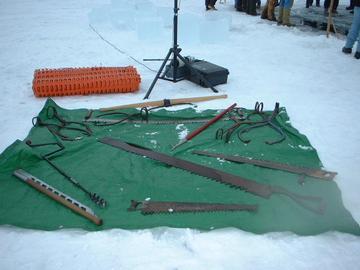
As I alluded to earlier, we used a cave that had been "enhanced" by opening it up some, while letting it remain basically a cave, to store some foods. Although the cellar, as we called it, stayed about 28F-32F (-2C-0C) year around, it wasn't actually cold enough overall to freeze food effectively. The main reason was that there were many drafts and more than a few "warm spots" which we had to avoid. Every winter, after the farm pond had sufficiently thick ice, we would spend one or more long weekends "harvesting" ice for the cave. This was done in part by use of the ice cutting and handling tools pictured above. The other photos show a remarkably similar heavy object/stump pulling hoist rig such as the one we had, and a wood stove similar to the two in the kitchen and one in the pantry, although the pantry stove was much wider with more oven and surface space. The rig was used to lift heavy stones from fields onto and off of the farm wagon, pulling stumps, and lifting ice blocks from the pond. This was accomplished by positioning the hoist over the object to be moved and utilizing heavy ropes and block and tackle assemblies. Although crude, these rigs allowed the slightest of men or boys to lift extremely heavy objects with ease, using the principles of mechanical advantage.
Prior to "re-icing" the cellar, everything in it was removed and the place thoroughly cleaned. Then the floor panels, which were set on 4X4 beams to allow drainage, were reinstalled. Then the walls were lined floor to ceiling with hay bales, which provided insulation. Only then was the cellar ready to add new ice. The hoist and ice tools were moved to the pond, which generally had ice over a meter thick and ideal for our purposes. The first thing done was to create a pilot hole in the center of the pond from which the ice removal progressed toward the edges. After this hole was cut, a larger square was cut with holes drilled at the four corners and one on the side opposite the pilot hole. The purpose of the pilot hole was as much to allow a place to cut from and allow the ice tongs in, as to center the operation.
Now the hoist was wheeled over the block to be removed and the tongs inserted into the holes on the sides as far as they would go. Uncle R had his own measuring method, which consisted of marking the blocks at two "axe handles" long by one "axe handle" wide. This worked out to a rectangle of ice roughly two meters long, one meter wide, one meter thick, and extremely heavy. So heavy in fact, that the farm wagon could carry only one at a time to the cellar entrance without fear of damage to the wagon. Getting the ice onto the wagon took a combination of moving the wagon and team into place as close as possible followed by R and F hoisting and manhandling the block into place to be lowered to the wagon bed. Once in the bed, it was held in place by iron pegs that fit into the "ice rails" installed to run in parallel from the front to the rear of the wagon bed.
The operation then moved to the cellar and the "tricky" part, as R would say. The west side of the cellar had one of the two doors leading to it, the other being on the south side and accessing the food pantry off the kitchen. Once there, the ice block was slid back in the wagon using block and tackle installed above the door. Prior to cutting, a specially designed three-rail ramp had been installed leading at about a forty-five degree angle through a short earthen "hallway" to the cellar floor. A block and tackle was used to lower the blocks slowly down the ramps until they settled on the floor. The floor was sturdy and level enough to allow the blocks to be slid and hoisted into their final spots. The room held four blocks along each side lengthwise, two regular and one half size on the north end, and two regular on the south end to allow for access from the pantry. These were stacked three blocks high. When completed, the west side door was fully blocked off by hay and ice and the "hall" filled with smaller blocks of ice to help prevent heat intrusion from the door. The pantry door was "insulated" by virtue of its being wood and approximately four inches thick, with a sheet steel surface on the cellar side. While not perfect, all these elements managed to accomplish the desired ends, a large, cold, reliable space for long-term storage of semi-perishable items, and short-term storage for perishable items.
When the room was ready, we'd restore the items which had been removed according to how soon we'd need access to the various items. The semi-perishable goods were generally home-canned foods and butter, along with other items I can't recall well enough to inventory. Barrels of potatos, corn, apples, and root vegetables were long-term also. Shorter lived things were mostly homemade sausage, raw fresh meats, eggs, and some fish. Many things, like fish, were kept on ice in addition to the cold of the room. Perishable things were mostly ground meat and dairy products. My aunt knew from long experience what would keep for how long and be useable, and directed the stowing of cellar goods like a plump, apron-clad general.
As the year wore on between seasons, the cellar was a constant source of amazement to me. I'd often ask to be allowed to take a flashlight or lantern down to retrieve needed things, simply so as to see how much the ice had melted since my last foray. It never receded appreciably on any of those occasions. I did, however, always manage to snag a juicy apple or two for my future snacking pleasure. We didn't have much in the way of candy, chips, or other denizens of todays cupboard shelves, and we were much healthier as a result. Our "treats" were apples, rhubarb, and maple sap flavored snow in spring. Nowadays I consider those things treats.
I don't know where R and F got their cellar knowledge, other than from their dad. I think it was one of the long-established methods of food storage passed down over the centuries. We had many stored foods beyond those in the cellar. My relatives who fished for a living would supply another relative with fish, we'd supply the needed varieties of wood, and my uncle and cousins would smoke the fish in a large one-story barn-like shed. Much of the fish was eaten by them, traded to us for the wood and some farm goods, and the remainder sold and shares of profits allotted between the fishing cousins and the smoking cousins. We always had smoked herring, salmon, flounder, and salted pollock, cod, and haddock available, as well as sardines from the canneries that still operated at that time.
Some foods were smoked by us, such as hams, turkeys, and wildfowl. We also had a time set aside for making sausages, jerky, dried and spiced beef strips, and corning beef. My aunt and Mrs F would spend days and weeks on end canning and preserving everything from various pickled fishes and pork cuts to jams and jellies. Almost all the vegetables grown would be grown in quantities to allow preserving jars of peas, beans, beets, rhubarb, etc for fall, winter, spring, and early summer use. Store bought food was a rarity, usually the store food money was saved for purchasing treats such as oranges, peaches, pears, and the like. The kitchen was a beehive of activity from the first harvests of early summer until late autumn. Just the smells emitting from the pantries and kitchen at these times was pure heaven.
When it came to meat, we generally raised a few beef cattle, pigs, chickens, turkeys, ducks, geese, and an occasional "meat" goat or two that were raised for that purpose. We also always had ample supplies of deer meats, bear meat, rabbit, squirrel, wildfowl, and freshly caught fish. Fresh fish were available via ice fishing in late fall and winter, and pole fishing at other times. Uncle R, F, Dad, myself, and some cousins and uncles would go as a group on my relative's boats deep-sea fishing several times a year also. In addition, other cousins fished for lobster or dug clams, which they'd trade us for farm or dairy goods. My aunt made the best batter coated, fried clams in the world, and they remain my favorite food to this day. Not the clam strips sold in stores, those are akin to cardboard, but whole clams where the clam explodes with flavor in your mouth on first bite and the flavor can be savored to the last, slow, drawn-out chew.
I often think that if someone could capture and bottle the aroma of food being canned, dinner roasting in one wood stove, and pies and bread baking in the other wood stove, they'd become a billionaire overnight. Those smells and the anticipation of tasty delights to come are a part of childhood that I fear is beyond reproducing. I think it's because of the "magic" my aunt put in every dish. Take care and enjoy life's little pleasures when you can.




 A Short Tale of Trees, Bees, and Treats
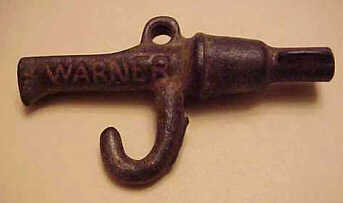
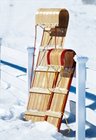
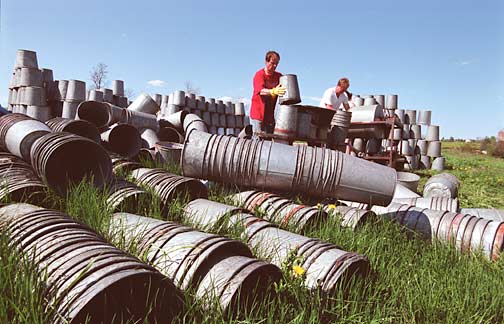
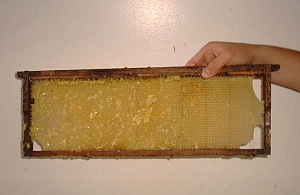
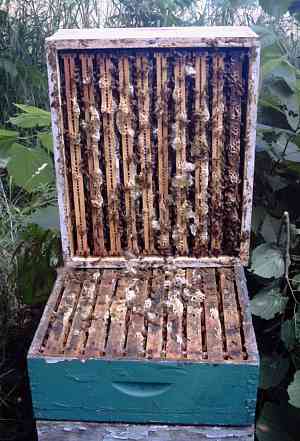
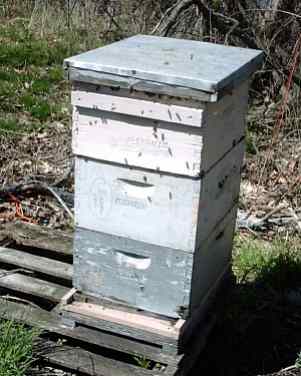
First, this post will not be the whole story of the maple sap gathering. I've left the converting of the sap to maple syrup, maple candy, and maple sugar for a later post which will follow fairly soon. I was going to include it all in one story, but photo uploading conspired against me and I had to trim the story to fit the photos. So, on to the explanation of the photos we have got. If all works well, they'll be in the proper order. First, a typical maple tree tap of the type we used to gather sap from the trees. A hole was drilled into the tree and the tap inserted. The center of the tap is hollow, forming a tube-like opening through which the sap flows. The hook is to secure the sap pail to the tree. Then toboggans of the type I used to haul the sap cans on while emptying the sap buckets. Now a sap gathering pail attached to a tree, cleaning the sap pails in summer to be ready for the sap harvest, and an example of pails on the trees in the forest in late winter-early spring. Then on to bee matters. First we have a section of a stackable hive showing the removable trays from which honey & comb is gathered. Next, a comb section removed from a hive, a stack of portable hives with the top section tilted to see inside. Now a set of hives showing typical placement in a field, lastly, a stack of hives ready to be placed around the farm fields.
We'll start with the trees part of the sweets story. I was much more involved with this aspect of farm work as R ran the "sugar house" each spring, an added task for several weeks that meant longer and harder hours than usual in order to extract a sweet bounty from the farm's multitude of scattered maple trees. The North American sugar maple tree has a unique quality to its yearly life cycle. After leafing out and growing all summer, the tree sends its sap to its roots every fall to protect the tree from freezing and splitting open. Then, after standing dormant all winter, the tree is activated by changing temperatures heralding spring and warmer weather, in which to resume growing. As this happens, toward the last days of winter and early spring, the sap again rises through the tree bringing nutrients to the limbs. Part of this nutrient mix in the maple tree is sugar, which is carried diluted in the sap. This is the bounty sought every spring by producers of maple syrup and all the related tasty treats. The sap is sweet enough to make a tasty treat of a handful of fresh snow when taken straight from the tree.
To get this sap, the trees are tapped as described above and pails hung. Then, every day at sunset or soon after, but before temperatures dropped too much, somebody would take several clean milk cans on two toboggans tied in tandem and gather the fresh sap. The somebody in those years being me, of course. Nowaday the bigger syrup producers have tubes running from tree to tree, and then to the sugar house for boiling down. We had literally hundreds of trees we tapped, and gathering by hand was a long and wearing process, repeated daily for three to four weeks every year, depending on how long the sap was running. A normal day would encompass four to five hours every evening of sap gathering. As I was the one going through the woods tree to tree and emptying the pails, F would go along the woods trails with his pride and joy, one of the first snow machines made in the early fifties. Prior to his purchasing it, the gathering was done with horse and sled.
As my milk cans got fuller and heavier, I'd work my way out to the trail and exchange them for fresh cans. F would then take the full cans on a sled behind his machine to the sugar house where they were emptied into holding barrels to await boiling. He'd then return to a point further along the trail to await my re-emergence with yet more of the precious liquid. So you won't think I slaved away steadily, I'll admit to taking a short breather every few trees and scooping up a handful of snow, dousing it with sap, and resting while eating my crude sno-cone style treat. I also carried with me extra pails and a "shoulder yoke, such as is seen even now in places, to carry the two pails on a wooden pole-like device across my neck and shoulders back to the toboggan. This was still quite an effort trudging through the snow with my sweet burden.
I don't know the specific amount of sap needed to make a gallon of syrup, but it's a lot, as the sugar house had an unquenchable thirst for the stuff once boiling started. It was all we, and the trees, could do to keep up with the demand since the sugar house boiled down sap twenty-four hours a day every day until the gathering was done and the last ounce of sweetness extracted. Then it would be cleaned and left to sit until the next spring, when it all would be repeated. I think I much prefer the modern method of sugar production, almost all sap gathering is automatic.
We'll go a little bit more into the sugar house operation in the next post. For now, I'd like to switch gears to another spring ritual, bee hive distribution. Honey gathering was done almost all summer and the bees tended to by F, which meant I had little to do with it. This was fine by me as, although not fearful of being stung, why expose yourself was my feeling then and now. As much as I love honey, I'd go without if it meant I'd have to handle the bee end of the deal. I much prefer to handle the part that involves dipping slices of fresh-picked apples into the stuff and savoring every bite. But, when lifting was involved, usually I was too.
Contrary to popular belief, bees do not hibernate during the cold months. They instead go into the center of the hive and, along with consuming the store of honey left for them for the winter, they form a dense pack with their bodies. The heat generated by this pack can reach temperatures up to 80F\27C at the center, thus protecting the bees on the coldest days. Of course, we helped them out a little bit also. Every fall F and I would go around the fields and gather up the stacks of hives and move them to a lean-to type structure that was open on the south side only. In this way, the hives always got the warming benefits of the sun and little of the cold north and west winds. This not only protected the bees, but it reduced the amount of honey they'd need for the winter to generate heat and lessened weathering's detrimental effects on the hives.
Then again each spring, F and I would return the hives to the various spots F had decided to place them for the summer. F was very up on bees and crop cross-pollination science. I say science, for it takes a scientific knowledge of things to get one of God's creatures to help grow his plants. Every year he'd figure out the best way to place the hives for maximum effect. The one constant was the four section stack hand carried through the woods to the small blueberry barren and another smaller hive carried in to the big berry thicket. The others were placed in hayfields, gardens, apple orchards, and in the wood lots. Then, throughout the summer, F would gather fresh honey and honeycomb both for us and to sell in his produce store in the small city.
This ensured that we always had bee's wax for my aunt to make candles and seal canning jars, and more importantly fresh honey for our toast, for topping hand-cranked ice cream, and as a vegetable and apple dip. This would be alternated with thick maple syrup saved aside for our use after F had taken the rest to sell. Every time I think of how hard life must have been then, I end up dwelling more on the delicious treats that always seemed to be so plentiful. It's then that I'd gladly trade an honest day of hard labor helping run the farm and all its many operations and demands for just one of my aunts meals, followed by pie & ice cream on the big veranda listening to my uncle's Red Sox game on the battery radio. Take care until the next time we can spend a few minutes roaming the corridors of my memory.
A Short Tale of Trees, Bees, and Treats
First, this post will not be the whole story of the maple sap gathering. I've left the converting of the sap to maple syrup, maple candy, and maple sugar for a later post which will follow fairly soon. I was going to include it all in one story, but photo uploading conspired against me and I had to trim the story to fit the photos. So, on to the explanation of the photos we have got. If all works well, they'll be in the proper order. First, a typical maple tree tap of the type we used to gather sap from the trees. A hole was drilled into the tree and the tap inserted. The center of the tap is hollow, forming a tube-like opening through which the sap flows. The hook is to secure the sap pail to the tree. Then toboggans of the type I used to haul the sap cans on while emptying the sap buckets. Now a sap gathering pail attached to a tree, cleaning the sap pails in summer to be ready for the sap harvest, and an example of pails on the trees in the forest in late winter-early spring. Then on to bee matters. First we have a section of a stackable hive showing the removable trays from which honey & comb is gathered. Next, a comb section removed from a hive, a stack of portable hives with the top section tilted to see inside. Now a set of hives showing typical placement in a field, lastly, a stack of hives ready to be placed around the farm fields.
We'll start with the trees part of the sweets story. I was much more involved with this aspect of farm work as R ran the "sugar house" each spring, an added task for several weeks that meant longer and harder hours than usual in order to extract a sweet bounty from the farm's multitude of scattered maple trees. The North American sugar maple tree has a unique quality to its yearly life cycle. After leafing out and growing all summer, the tree sends its sap to its roots every fall to protect the tree from freezing and splitting open. Then, after standing dormant all winter, the tree is activated by changing temperatures heralding spring and warmer weather, in which to resume growing. As this happens, toward the last days of winter and early spring, the sap again rises through the tree bringing nutrients to the limbs. Part of this nutrient mix in the maple tree is sugar, which is carried diluted in the sap. This is the bounty sought every spring by producers of maple syrup and all the related tasty treats. The sap is sweet enough to make a tasty treat of a handful of fresh snow when taken straight from the tree.
To get this sap, the trees are tapped as described above and pails hung. Then, every day at sunset or soon after, but before temperatures dropped too much, somebody would take several clean milk cans on two toboggans tied in tandem and gather the fresh sap. The somebody in those years being me, of course. Nowaday the bigger syrup producers have tubes running from tree to tree, and then to the sugar house for boiling down. We had literally hundreds of trees we tapped, and gathering by hand was a long and wearing process, repeated daily for three to four weeks every year, depending on how long the sap was running. A normal day would encompass four to five hours every evening of sap gathering. As I was the one going through the woods tree to tree and emptying the pails, F would go along the woods trails with his pride and joy, one of the first snow machines made in the early fifties. Prior to his purchasing it, the gathering was done with horse and sled.
As my milk cans got fuller and heavier, I'd work my way out to the trail and exchange them for fresh cans. F would then take the full cans on a sled behind his machine to the sugar house where they were emptied into holding barrels to await boiling. He'd then return to a point further along the trail to await my re-emergence with yet more of the precious liquid. So you won't think I slaved away steadily, I'll admit to taking a short breather every few trees and scooping up a handful of snow, dousing it with sap, and resting while eating my crude sno-cone style treat. I also carried with me extra pails and a "shoulder yoke, such as is seen even now in places, to carry the two pails on a wooden pole-like device across my neck and shoulders back to the toboggan. This was still quite an effort trudging through the snow with my sweet burden.
I don't know the specific amount of sap needed to make a gallon of syrup, but it's a lot, as the sugar house had an unquenchable thirst for the stuff once boiling started. It was all we, and the trees, could do to keep up with the demand since the sugar house boiled down sap twenty-four hours a day every day until the gathering was done and the last ounce of sweetness extracted. Then it would be cleaned and left to sit until the next spring, when it all would be repeated. I think I much prefer the modern method of sugar production, almost all sap gathering is automatic.
We'll go a little bit more into the sugar house operation in the next post. For now, I'd like to switch gears to another spring ritual, bee hive distribution. Honey gathering was done almost all summer and the bees tended to by F, which meant I had little to do with it. This was fine by me as, although not fearful of being stung, why expose yourself was my feeling then and now. As much as I love honey, I'd go without if it meant I'd have to handle the bee end of the deal. I much prefer to handle the part that involves dipping slices of fresh-picked apples into the stuff and savoring every bite. But, when lifting was involved, usually I was too.
Contrary to popular belief, bees do not hibernate during the cold months. They instead go into the center of the hive and, along with consuming the store of honey left for them for the winter, they form a dense pack with their bodies. The heat generated by this pack can reach temperatures up to 80F\27C at the center, thus protecting the bees on the coldest days. Of course, we helped them out a little bit also. Every fall F and I would go around the fields and gather up the stacks of hives and move them to a lean-to type structure that was open on the south side only. In this way, the hives always got the warming benefits of the sun and little of the cold north and west winds. This not only protected the bees, but it reduced the amount of honey they'd need for the winter to generate heat and lessened weathering's detrimental effects on the hives.
Then again each spring, F and I would return the hives to the various spots F had decided to place them for the summer. F was very up on bees and crop cross-pollination science. I say science, for it takes a scientific knowledge of things to get one of God's creatures to help grow his plants. Every year he'd figure out the best way to place the hives for maximum effect. The one constant was the four section stack hand carried through the woods to the small blueberry barren and another smaller hive carried in to the big berry thicket. The others were placed in hayfields, gardens, apple orchards, and in the wood lots. Then, throughout the summer, F would gather fresh honey and honeycomb both for us and to sell in his produce store in the small city.
This ensured that we always had bee's wax for my aunt to make candles and seal canning jars, and more importantly fresh honey for our toast, for topping hand-cranked ice cream, and as a vegetable and apple dip. This would be alternated with thick maple syrup saved aside for our use after F had taken the rest to sell. Every time I think of how hard life must have been then, I end up dwelling more on the delicious treats that always seemed to be so plentiful. It's then that I'd gladly trade an honest day of hard labor helping run the farm and all its many operations and demands for just one of my aunts meals, followed by pie & ice cream on the big veranda listening to my uncle's Red Sox game on the battery radio. Take care until the next time we can spend a few minutes roaming the corridors of my memory.